Since I'm a new geisha, I don't have my own regular customers. So I sent invitation emails to some of my close friends to inform them of my new job so that they might want to attend my parties.
Not only was I trying to promote myself, I also wanted them to know about the geisha world.
Generally they don't know much about geisha and ozashiki parties.
At first, I posted some articles about the Hachioji geisha on one SNS site, enticing my readers that if they were interested in the Hacioji geisha to let me know.
However only a few of my friends commented on my articles. I was very disappointed.
So I sent some emails directly to them.
3 friends replied that they were interested in Hachioji geisha, and 1 friend planned a special party to bring new customers.
They invited their friends to come to the special party, which we named "Ozashiki experience".
At first, not so many people were interested in the "Ozashiki experience", however finally I was able to book in 10 customers. I was very glad.
I requested 2 "O-ne-san", geisha sisters, to join the party and entertain my friends and friends' friends with me. The O-ne-sans agreed to my request.
My O-ne-sans and I planned to entertain my new customers with traditional Japanese dance, some kinds of "Ozashiki-asobi", traditional games, and Rakugo.
As for my shamisen performance, as I already wrote in my previous article, my geisha mother wouldn't allow me to perform solo as a "Zikata" who is the professional accompanist to the dancing.
Nevertheless she allowed me to perform solo as an additional entertainment.
I was very glad to entertain the guests with my shamisen, because one of their purposes of coming to Hachioji was to see my activity.
Finally the special day came.
We usually entertain regular customers who are used to the Hachioji geisha. So, for my geisha sisters and me, the "Ozashiki experience" for our new customers was a rare experience.
The length of the party was decided to be about 2 hours. So the most senior o-ne-san instructed us to complete all parts of the program within the time limit of the party.
I really appreciate her, because her management was perfect, so my friends could really enjoy the party.
As for my shamisen performance, I didn't make any mistakes. I think I'm getting used to performing solo little by little. While I was playing, I saw that everyone was taking photos.
As for my Rakugo, everyone laughed, and some of my friends said to me that my Rakugo was very nice and interesting. I was really glad.
After the party, I talked with my geisha sisters. They said to me that it was a wonderful party, because they could feel the customers enjoyment of the party.
Of course, my friends are very nice people, and my friends' friends too.
They all created a wonderful atmosphere at the party.
After the party I received a request to host another party from my friend's friend. I'm glad to have the opportunity to host second party as a result of this one.
2010年11月26日金曜日

2010年11月11日木曜日
My first solo shamisen performance
Even though I have played the shamisen with my "Oka-san", geisha mother and my "O-ne-san", geisha sisters, many times at parties, I've not played the shamisen solo as a "Zikata", a musical accompanist to dancers, yet.
My oka-san said to me that my skill as a soloist was not up to professional standard yet, so I should play the shamisen with her or my o-ne-sans.
Actually when I passed her assessment of my playing on my birthday, I misunderstood that I could only play the shamisen solo the song which she had assessed me on.
However actually she just permitted that I could play that song together with her.
One day, I asked her whether I could play the shamisen solo at a special party in which my friends and friends' friends were customers, because one of their purpose of attending the party was to see my activity as a geisha.
They knew that I had wanted to play the shamisen as a "Zikata", which is why I became a full-time geisha.
However when I requested my oka-san's permission, she didn't allow me to play the shamisen solo even though it was only in front of my friends. I was shocked.
After several days, she unexpectedly sent me an email in the morning.
In her email, she wanted me to play the shamisen solo at that day's evening party.
I was confused, however I soon realized that it was out of her kindness that she would give me a chance.
Before the party, she checked my performance again. I played the song which she had requested me to play at the party.
I really got tense, because she sat very close in front of me.
In addition, unfortunately, one string suddenly broke, so I had to change it rapidly.
In fact, it's difficult to tune the shamisen, because shamisen strings are prone stretch, especially after stringing.
When my shamisen string broke, I didn't stretch it thoroughly while I was stringing it, so during my performance, my shamisen was out of tune.
Furthermore, I'm not used to tuning while playing.
My oka-san said to me that when I play the shamisen solo, I should be able to change the strings and tune them smoothly by myself.
I realized that I wasn't yet ready to perform as a professional "Zikata".
She also pointed out somethings about my singing. She said to me that my vocalization had too much of a rural twang, so I should enunciate my voice more clearly.
She added that my performance at the party was just optional entertainment, not as a professional "Zikata".
She also said to me that she would dance with my performance.
I felt nervous, however I really felt her kindness at the same time.
At the party, I didn't want to drink, even if the customers requested me to drink together, because I was afraid that if I drunk, I wouldn't be able to play the shamisen perfectly. However in the end I drunk a bit.
Finally, the time of our performance came. I felt my face became red. I realized that I was panicking, because it was my first time to play the shamisen solo.
I desperately played the shamisen while I was singing. While I was playing, I followed my oka-san's dance.
I was very happy after I finished playing.
Some customers said to my oka-san and me that my shamisen and singing were good, and I might have a good sense of shamisen performance. I was really glad.
However through this experience, I realized that I really relied heavily on oka-san's performance.
I have decided to do my best to become a professional "Zikata", not just a shamisen player.
My oka-san said to me that my skill as a soloist was not up to professional standard yet, so I should play the shamisen with her or my o-ne-sans.
Actually when I passed her assessment of my playing on my birthday, I misunderstood that I could only play the shamisen solo the song which she had assessed me on.
However actually she just permitted that I could play that song together with her.
One day, I asked her whether I could play the shamisen solo at a special party in which my friends and friends' friends were customers, because one of their purpose of attending the party was to see my activity as a geisha.
They knew that I had wanted to play the shamisen as a "Zikata", which is why I became a full-time geisha.
However when I requested my oka-san's permission, she didn't allow me to play the shamisen solo even though it was only in front of my friends. I was shocked.
After several days, she unexpectedly sent me an email in the morning.
In her email, she wanted me to play the shamisen solo at that day's evening party.
I was confused, however I soon realized that it was out of her kindness that she would give me a chance.
Before the party, she checked my performance again. I played the song which she had requested me to play at the party.
I really got tense, because she sat very close in front of me.
In addition, unfortunately, one string suddenly broke, so I had to change it rapidly.
In fact, it's difficult to tune the shamisen, because shamisen strings are prone stretch, especially after stringing.
When my shamisen string broke, I didn't stretch it thoroughly while I was stringing it, so during my performance, my shamisen was out of tune.
Furthermore, I'm not used to tuning while playing.
My oka-san said to me that when I play the shamisen solo, I should be able to change the strings and tune them smoothly by myself.
I realized that I wasn't yet ready to perform as a professional "Zikata".
She also pointed out somethings about my singing. She said to me that my vocalization had too much of a rural twang, so I should enunciate my voice more clearly.
She added that my performance at the party was just optional entertainment, not as a professional "Zikata".
She also said to me that she would dance with my performance.
I felt nervous, however I really felt her kindness at the same time.
At the party, I didn't want to drink, even if the customers requested me to drink together, because I was afraid that if I drunk, I wouldn't be able to play the shamisen perfectly. However in the end I drunk a bit.
Finally, the time of our performance came. I felt my face became red. I realized that I was panicking, because it was my first time to play the shamisen solo.
I desperately played the shamisen while I was singing. While I was playing, I followed my oka-san's dance.
I was very happy after I finished playing.
Some customers said to my oka-san and me that my shamisen and singing were good, and I might have a good sense of shamisen performance. I was really glad.
However through this experience, I realized that I really relied heavily on oka-san's performance.
I have decided to do my best to become a professional "Zikata", not just a shamisen player.
2010年11月8日月曜日
My first time to play the Taiko at a party
At one big party last weekend, I played the "Taiko", which is formally called a "Shime-daiko".
At the "Ozashiki", parties, the taiko is as popular as the shamisen, so some geisha learn it.
After my shamisen teacher lent me his tsuzumi, I started taking tsudumi lessons. I soon started to like the tsudumi.
Both the taiko and the tsudumi are part of the family of instruments called "Narimono". "Nari" means "Beat" and "Mono" means "Instrument".
I also started to have an interest in the taiko, so I asked my geisha sister when I could start taking taiko lessons, because my other geisha sisters were learning the taiko from the same teacher.
She replied that after I was able to play the tsudumi well, I would be able to receive taiko lessons.
When I heard this from her, I couldn't understand her reason.
However now I can understand, because I experienced playing the taiko and I realized that it's difficult to play the taiko.
One day, my geisha mother said to me that she wanted me to play the taiko at a party, because another geisha who usually plays the taiko couldn't attend the party.
To tell the truth, she only gave me 1 week's notice.
One geisha sister who usually perform the taiko, taught me how to play it, and after several days of taking her lesson, I had a group practice session with my geisha mother.
Even though I practiced it considerably, I couldn't play it well when accompanying her shamisen.
I had been practicing it with just a CD for accompaniment, so I found it difficult when I had to play with an actual shamisen player.
I noticed that I was struggling to understand the "Ma(間)", rhythm of the music.
In traditional Japanese songs, the "Ma" is different from that of western music, so it's difficult to get used to playing the taiko to traditional Japanese songs.
My geisha mother pointed out not only my playing technique but also my posture were incorrect.
During our lesson, I couldn't play one part of the song correctly, so she said to me that if I couldn't play that part, I should play that part with the same rhythm as the other parts.
However, She insisted that she wanted me to try to play that difficult part.
I really appreciated her kindness, and I wanted to live up to her expectation.
So I practiced the taiko very hard everyday before the party, and at the second group session with my geisha mother, I could play it without any mistakes. She looked really glad.
On the day of the party, I could play the taiko perfectly.
After that party, my geisha mother called me to perform at another ozashiki as a taiko player. I was really glad.
That night, I called my shamisen teacher.
I talked to him about my wonderful experience expressing my gratitude, because if he hadn't have lent me his tsudumi, I wouldn't have started tsudumi lessons.
I want to learn the taiko more, and become a more versatile geisha.
At the "Ozashiki", parties, the taiko is as popular as the shamisen, so some geisha learn it.
After my shamisen teacher lent me his tsuzumi, I started taking tsudumi lessons. I soon started to like the tsudumi.
Both the taiko and the tsudumi are part of the family of instruments called "Narimono". "Nari" means "Beat" and "Mono" means "Instrument".
I also started to have an interest in the taiko, so I asked my geisha sister when I could start taking taiko lessons, because my other geisha sisters were learning the taiko from the same teacher.
She replied that after I was able to play the tsudumi well, I would be able to receive taiko lessons.
When I heard this from her, I couldn't understand her reason.
However now I can understand, because I experienced playing the taiko and I realized that it's difficult to play the taiko.
One day, my geisha mother said to me that she wanted me to play the taiko at a party, because another geisha who usually plays the taiko couldn't attend the party.
To tell the truth, she only gave me 1 week's notice.
One geisha sister who usually perform the taiko, taught me how to play it, and after several days of taking her lesson, I had a group practice session with my geisha mother.
Even though I practiced it considerably, I couldn't play it well when accompanying her shamisen.
I had been practicing it with just a CD for accompaniment, so I found it difficult when I had to play with an actual shamisen player.
I noticed that I was struggling to understand the "Ma(間)", rhythm of the music.
In traditional Japanese songs, the "Ma" is different from that of western music, so it's difficult to get used to playing the taiko to traditional Japanese songs.
My geisha mother pointed out not only my playing technique but also my posture were incorrect.
During our lesson, I couldn't play one part of the song correctly, so she said to me that if I couldn't play that part, I should play that part with the same rhythm as the other parts.
However, She insisted that she wanted me to try to play that difficult part.
I really appreciated her kindness, and I wanted to live up to her expectation.
So I practiced the taiko very hard everyday before the party, and at the second group session with my geisha mother, I could play it without any mistakes. She looked really glad.
On the day of the party, I could play the taiko perfectly.
After that party, my geisha mother called me to perform at another ozashiki as a taiko player. I was really glad.
That night, I called my shamisen teacher.
I talked to him about my wonderful experience expressing my gratitude, because if he hadn't have lent me his tsudumi, I wouldn't have started tsudumi lessons.
I want to learn the taiko more, and become a more versatile geisha.
2010年11月2日火曜日
A geisha's lifestyle
Some people, not only my foreign friends but also my Japanese friends, sometimes ask me about a geisha's life style.
Even though I don't know about other "Karyu-kai(花柳界)", areas in which geisha are working, let me write about my life style as a geisha in Hachioji.
I usually wake up around 7am or 8am, eat breakfast and check email.
After checking my email, I iron some undergarments of kimono, which takes about 15 minutes.
After ironing, I put on my make up and practice the shamisen, At around 1pm I leave my apartment for Hachioji.
From my place of residence area to my working place, Hachioji, it takes about 45 minutes by train, so I usually listen to shamisen music as part of my practice or read books in the train.
Some people say that it's very tiring to spend 2 hours commuting everyday, however for me the time in the train is very important in order to learn some new things.
Every 2 or 3 days, I go to the hair salon, which most of the geisha in Hachioji go to in order to have our hair set in "You-hatsu" style.
We usually don't have our hair set in "Nihon-gami(日本髪)" style, which is just for special events. Our daily hairstyle is called "You-hatsu(洋髪)".
It takes about 30-40 minutes to have our hair set.
Our hair stylist has a special technique, however the hair stylists who can set a geisha's hair are becoming rare in Japan.
The "Ozashiki(お座敷)", parties, usually start between 5-7pm, so we start putting on our kimonos, which we borrow from our geisha mother, at about 4-4:30pm.
Most of us, except for the new geisha, can put on a kimono by ourselves, but in order to fit them beautifully, we help each other.
By the way, we don't usually wear a long and black kimono except for special parties and during the new year season.
We usually wear "Tsukesage(付け下げ)"or "Komon(小紋)" kimonos.
There are various types of kimono, such as "Tsukesage" and "Komon", that are worn according to the formality of the "Ozashiki".
If I don't have any parties, I wait at the Okiya for someone to call me, and practice the shamisen or the tsudumi after putting on my kimono.
After the evening's parties, I go back to my apartment. The time to reach home is different everyday, because if I have 2 or 3 parties in an evening, I have to work till midnight.
After going back to my apartment, I have a bath, however I don't wash my hair.
To tell the truth, I keep my hairstyle for about 2 or 3 days, so I wrap my hair with a scarf to keep it in a shape.
At first, it was difficult to sleep well, however I'm getting used to it a bit now.
The above scenario is my usual daily lifestyle, however sometimes I have a shamisen or tsudumi lesson in the morning, or a group practice session with other geisha in which case I have to go to work early in the morning.
Most of the geisha are learning dance, the shamisen, the tsudumi, the Japanese flute and/or the tea ceremony, so we are very busy every day.
In my case, I'm learning only the shamisen and the tsudumi now, however from December I'll start to learn dance too.
So I imagine I'll be more busy than now.
Even though I don't know about other "Karyu-kai(花柳界)", areas in which geisha are working, let me write about my life style as a geisha in Hachioji.
I usually wake up around 7am or 8am, eat breakfast and check email.
After checking my email, I iron some undergarments of kimono, which takes about 15 minutes.
After ironing, I put on my make up and practice the shamisen, At around 1pm I leave my apartment for Hachioji.
From my place of residence area to my working place, Hachioji, it takes about 45 minutes by train, so I usually listen to shamisen music as part of my practice or read books in the train.
Some people say that it's very tiring to spend 2 hours commuting everyday, however for me the time in the train is very important in order to learn some new things.
Every 2 or 3 days, I go to the hair salon, which most of the geisha in Hachioji go to in order to have our hair set in "You-hatsu" style.
We usually don't have our hair set in "Nihon-gami(日本髪)" style, which is just for special events. Our daily hairstyle is called "You-hatsu(洋髪)".
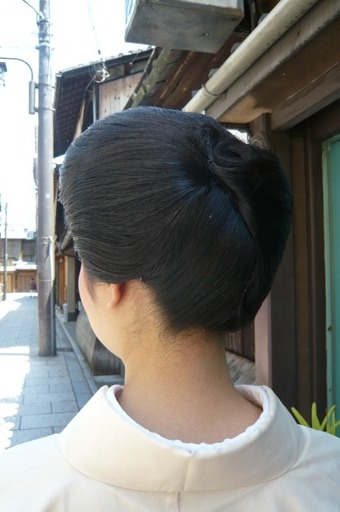
It takes about 30-40 minutes to have our hair set.
Our hair stylist has a special technique, however the hair stylists who can set a geisha's hair are becoming rare in Japan.
The "Ozashiki(お座敷)", parties, usually start between 5-7pm, so we start putting on our kimonos, which we borrow from our geisha mother, at about 4-4:30pm.
Most of us, except for the new geisha, can put on a kimono by ourselves, but in order to fit them beautifully, we help each other.
By the way, we don't usually wear a long and black kimono except for special parties and during the new year season.
We usually wear "Tsukesage(付け下げ)"or "Komon(小紋)" kimonos.
There are various types of kimono, such as "Tsukesage" and "Komon", that are worn according to the formality of the "Ozashiki".
If I don't have any parties, I wait at the Okiya for someone to call me, and practice the shamisen or the tsudumi after putting on my kimono.
After the evening's parties, I go back to my apartment. The time to reach home is different everyday, because if I have 2 or 3 parties in an evening, I have to work till midnight.
After going back to my apartment, I have a bath, however I don't wash my hair.
To tell the truth, I keep my hairstyle for about 2 or 3 days, so I wrap my hair with a scarf to keep it in a shape.
At first, it was difficult to sleep well, however I'm getting used to it a bit now.
The above scenario is my usual daily lifestyle, however sometimes I have a shamisen or tsudumi lesson in the morning, or a group practice session with other geisha in which case I have to go to work early in the morning.
Most of the geisha are learning dance, the shamisen, the tsudumi, the Japanese flute and/or the tea ceremony, so we are very busy every day.
In my case, I'm learning only the shamisen and the tsudumi now, however from December I'll start to learn dance too.
So I imagine I'll be more busy than now.
登録:
投稿 (Atom)